

Wall panels or tiles, it sounds like a simple choice, but it shapes your budget, your cleaning routine, and potentially how your home sells in five years. Both options work. Neither are universally better. The real question is what is your style, and the answer is different for every home and bathroom.
At Vortex Bathrooms, this is one of the first conversations we have with clients during a free initial design visit. It is not about steering anyone toward a particular product. It is about understanding the room, the budget, and how the household actually uses the space, because the right finish for a busy family main bathroom is rarely the same as the right finish for a sleek wet room en-suite. By the end of this article, you will know where each option genuinely wins and have a short checklist to make the call for your specific situation.
What shower wall panels actually are
Panels are not a single product. They are a category with meaningful differences inside it, and treating all panels as equivalent is one of the most common mistakes people make when comparing shower wall panels or tiles side by side.
The three main types you will encounter in the UK market are PVC, wood (MDF/ Plywood), and acrylic. PVC is the entry-level option: lightweight, budget-friendly, and the easiest to handle for a DIY install. Wood MDF/ Plywood is denser, heavier, and a lot more of the common practice. However MDF panels are made of wood, and if not installed correctly can warp expand very easily. Acrylic sits in the middle, valued for its smooth, seamless finish and easy-clean surface, though its scratch resistance and performance under sustained heat vary by product.
On the other side sit ceramic, porcelain and natural stone tiles, which remain the default finish in UK bathrooms for good reason. They offer an enormous range of design options, a lifespan that can stretch well beyond 30 years when installed correctly, and a finish that most buyers recognise as a quality indicator. The trade-off is that they take longer to install, can cost slightly more when all the materials are included, and can demand more in ongoing maintenance.
Shower wall panels or tiles: the real cost difference
Cost: shower panels vs tiles
Let’s deal with the numbers directly. In the UK in 2026, waterproof shower panels typically run around £40m² – £90/m² depending on material type. PVC panels sit at the lower end of that range, Wood sits between the middle to high end along with acrylic panels. Ceramic tiles come in at roughly £30m² – £105m², with porcelain rising to £40m² – £150/m² depending on format and finish. These ranges reflect typical UK market pricing across varying suppliers and complexity of the tiles. Large-format porcelain, currently one of the most popular choices in contemporary bathrooms, sits firmly at the higher end of that range.
Panel suppliers commonly position panels as cheaper than tiling on a like-to-like area, once you include labour and materials. but the majority of the time that is not correct, on a like for like basis the prices are almost identical. For panels – what you save in the cost of labour and tiling materials is absorbed by the cost of the panels, and the same vice-vera – what you save in panel costs is absorbed by the labour and materials for tiling.
The big advantage with panels is that they are a lot easier to fit. if we look at a standard bathroom; tiling the room would take about 5 days to do all the walls and floors, if we did it in panels it would take about 2 days for the walls and 1/2 a day to a day for the floor
If budget and installation speed are your primary drivers, panels win. If you are prepared to spend more upfront for a finish with greater longevity and design range, tiles are the stronger investment.
Waterproofing, maintenance and grout-free shower walls
Maintenance of grout-free shower walls
Grout is the weak point of any tiled shower area. It can stain easily in hard-water areas, and, if it fails or is not properly maintained. That is why large format tile, and minimal grout lines are becoming more common – if there are virtually no grout lines – how can the grout get damaged.
Bathroom wall panels, are large non-porous sheets with minimal joints, but they can have their failings too. Most of the PVC panels use a honeycomb effect to make their structure, they might not leak – but they are easier to damage when compared to tiles. The wood panels use MDF or Plywood for the base material and if they are not sealed fully, siliconed in the right places or get damaged after fitting they can swell, warp and eventually blow.
All bathroom coverings can have their faults and water always finds a way, it’s why we always recommend they get fitted by a professional – not only does it give you a greater piece of mind, but most work will come with also come with a guarantee.

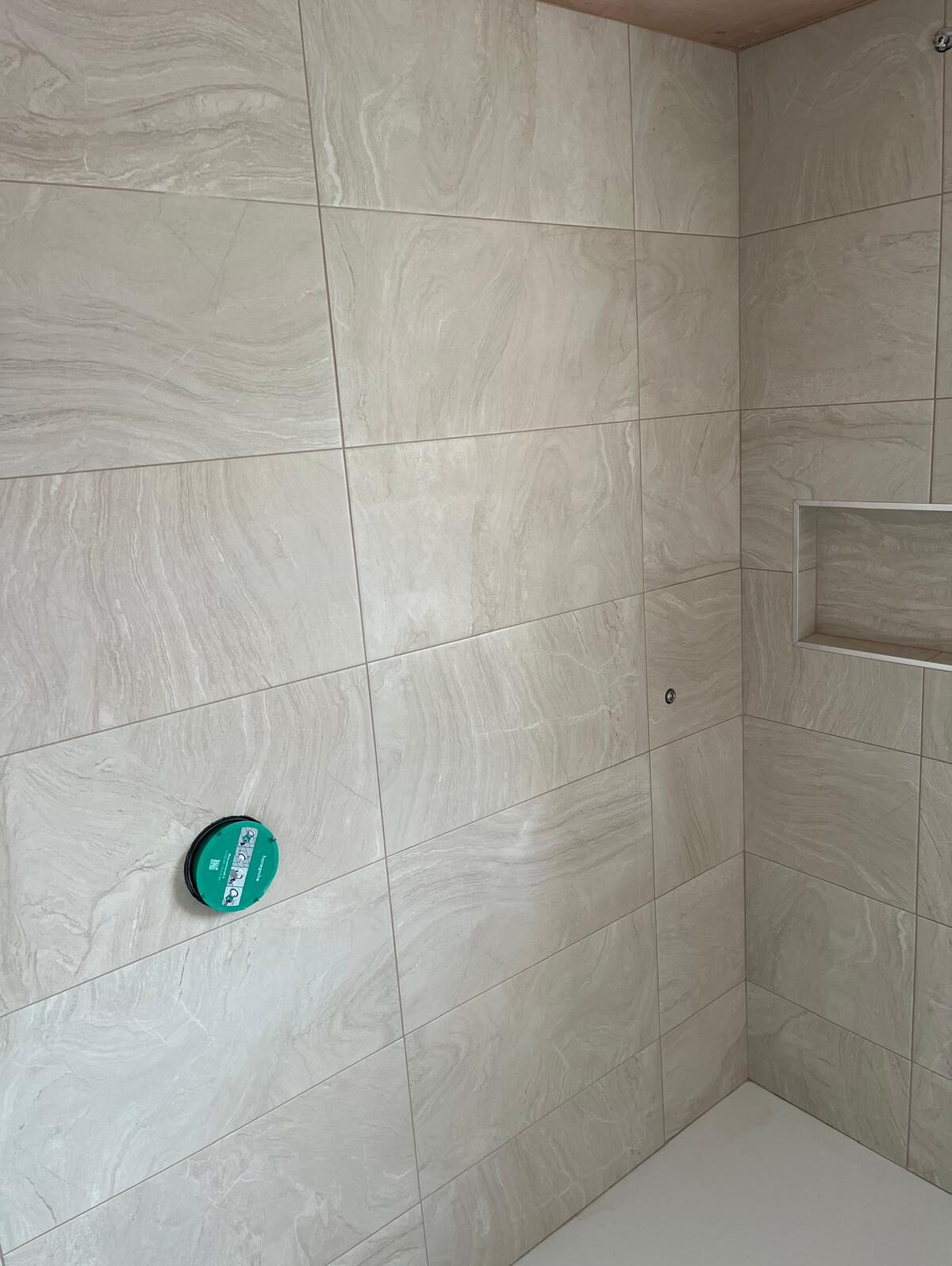
Durability and lifespan: what actually fails first
Tiles have the clear advantage on raw lifespan. Ceramic and porcelain can last 30 to 50 years and beyond when the full system, including the membrane, adhesive, and grout, is installed to a high standard. Mainstream shower wall cladding alternatives typically run 10 to 20 years, with premium wet wall cladding systems pushing that up to possibly 25 years. UK warranty patterns reflect the quality spread: budget PVC panels typically carry five to ten years and mid to high end range products ten to twenty years, based on current manufacturer offerings in the UK market.
But the comparison is not as clean as those numbers suggest, because tiles rarely fail at the tile itself. They fail at the grout, the sealant, or the substrate behind them. A tiled shower installed with poor waterproofing preparation, or neglected for a few years, can deteriorate much faster than the tile lifespan implies. Panel failure modes, by contrast, include seam separation, surface scratching, and yellowing over time, particularly with lower-quality PVC products exposed to UV or strong cleaning agents.
The honest position is this: a well-installed tiled shower with a quality tile and a correctly tanked substrate will outlast most panel systems. A poorly installed shower can fail fast, regardless of material. Installation quality drives lifespan in both cases, which is why who does the work matters as much as what material you choose.
Aesthetics and the design gap
Tiles still offer the widest design range available. Large-format porcelain, handmade ceramics, mosaic insets, textured stone effects with varied grout colour options: none of that design flexibility is possible with a standard panel system. For homeowners who want a specific look, or who are designing a bathroom that needs to make a real visual statement, tiles remain the superior creative tool.
The gap has narrowed, though. Tile effect wall panels have improved significantly in recent years, and quality SPC systems can now convincingly replicate marble, concrete, and natural stone finishes. For a clean, contemporary wet room or a secondary bathroom where simplicity is the goal, panels can deliver a result that looks genuinely considered, particularly in a contemporary or minimalist space.
On home resale value, the evidence leans toward tiles. Large-format porcelain, in particular, reads as a quality finish to buyers and tends to support sale price, though formal estate agent data on this point is limited, and individual market conditions will vary. Panels can raise questions if they look dated or budget, and even well-installed panels generally carry a lower perceived premium than a quality tile finish. The safest position for long-term resale is a well-installed tile finish with a quality material.
The honest verdict
Panels win on installation speed, and low-maintenance living. Tiles win on longevity, design range, and resale perception. The decision depends on your preferences, and which of those priorities matters most in your bathroom.
One thing worth emphasising for anyone considering a wet room specifically: the question of shower panels vs tiles is only half the decision. You need to make sure the material you are using – panel or tiles – are suitable for a wet room. A lot of people say panels are better, as the panels are bigger and have less joints , which is correct, but not the full story; in a wet room you need to fully seal between the walls and floors and that is a lot easier with tiles and, aesthetically, will look a lot better in tiles, using a grout colour matched silicone to seal the joints makes the room a lot more seamless.
If you want to talk through tiles or panels for bathrooms, or anything else about your specific project, get in touch with the Vortex Bathrooms team. We cover the West Midlands, Warwickshire, Worcestershire and the first design visit is free. Book your free West Midlands design visit and you will leave with a clear picture of what makes sense for your room, your budget, and how you actually want to live in the space.