
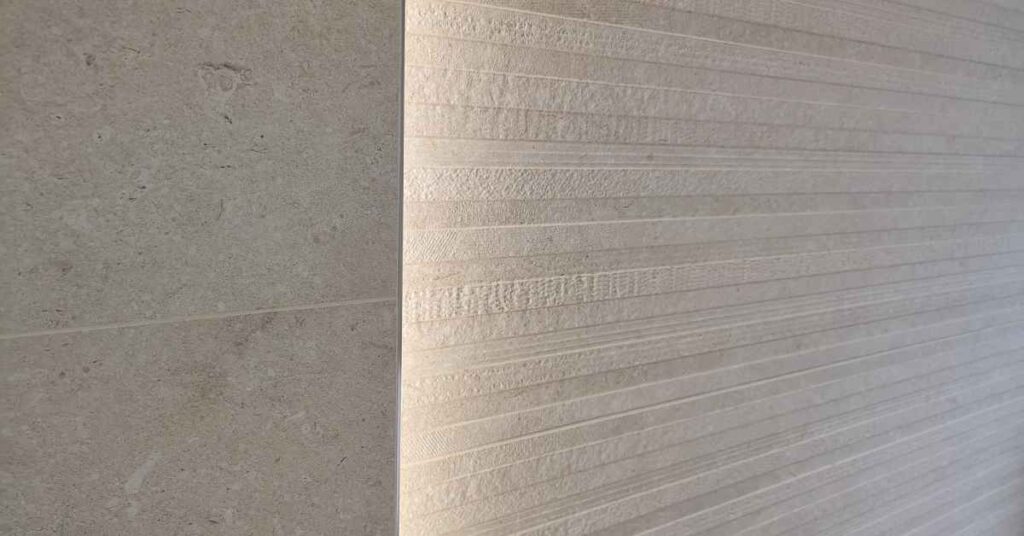
Walk into a bathroom tiled with genuinely large-format slabs with rectified edges and you notice it immediately: the floor reads as one continuous surface, the grout lines almost disappear, and the whole room feels calmer and more spacious than the physical dimensions suggest. Oversized tiles for bathrooms have become increasingly popular in UK renovations, and the reasons are practical as much as aesthetic. This extra large/ oversized tiles bathroom guide covers the sizes that actually work for different room scales, the layout and grout strategies worth knowing, what a proper installation involves, and what to budget realistically. At Vortex Bathrooms, we specify and fit large-format tiles regularly, so what follows draws on what we see working, and what we see going wrong, on real projects.
What counts as oversized and which size suits your bathroom
The term “large-format” generally starts at 333×1000mm. Anything from 1200×1200mm upward is genuinely oversized, and slab formats such as 1200×2400mm occupy their own category: they are closer to architectural stone panels than conventional tiles. Standard large-format porcelain is sold in individual tiles for domestic use; slabs often require specialist supply, handling equipment, and a full quote rather than a standard price per m².
Matching tile size to room scale
Matching size to room is the first practical decision in any oversized tiles bathroom project. In a small or standard bathroom, 600×600mm or 600×1200mm is the sweet spot: you get the open, low-grout-line effect without excessive cuts and waste. Medium-sized bathrooms suit 600×1200mm or 596x1500mm for the walls and 800×800mm for the floor, balancing visual impact with manageable layout control. Large bathrooms are where 1200×1200mm and 1200×2400mm deliver the architectural, seamless quality people are usually aiming for, but they demand a genuinely flat substrate, and that has cost implications. As a practical rule of thumb, the tile should feel proportionate to the room, neither so large it dominates the space nor so small the benefit is lost.
How large-format tiles transform the feel of a space
The visual principle is straightforward. Grout lines act as a grid that breaks up the surface and anchors the eye. Reduce them, and the eye travels further without interruption. In practice, this makes a modest bathroom feel more open and less busy without changing a single dimension. Less grout also means less mould, less scrubbing, and fewer joints to re-seal over time, the maintenance benefit is real and compounds over years.
The trade-offs are worth stating honestly. Smooth, polished large-format tiles on a wet floor are a slip risk. Fewer grout lines underfoot can reduce grip, and this matters in a shower or wet room where the floor is regularly wet. The fix is straightforward: use a matte or textured finished tile with a slip rating of at least R10 for a standard bathroom floor, and R11 or PTV 36+ for a wet room or walk-in shower. That gets you the clean look without the safety compromise. The other honest caveat: big tiles on bathroom floors reveal substrate imperfections far more readily than small tiles do. Any unevenness telegraphs through. This is not a reason to avoid them; it is a reason to take surface preparation seriously.
Slip Rating Tests
Most of us look only look at slip ratings when we are looking at floor tiles, and then completely forget about them – we thought it would be a good thing to include what the ramp test is, how it is administered, and what the ratings mean. The Ramp test produces a R value based on how slippy a floor surface is that is covered in oil. This is done by an operator wearing safety boots walking up and down on the oil covered floor sample on an adjustable ramp – the higher the angle of sample before the operator slips, the higher the R rating.
R Ratings
- R9; 6-10⁰, minimal slip resistance
- R10; 10 -19⁰, Basic slip resistance, good for light commercial spaces
- R11; 19-27⁰, Medium slip resistance, Ideal for commercial kitchens
- R12; 27-35⁰, High slip resistance, Ideal for large commercial kitchens
- R13; >35⁰, Very high slip resistance, Ideal for external spaces (if porcelain), and areas where water is constant, or highly likely
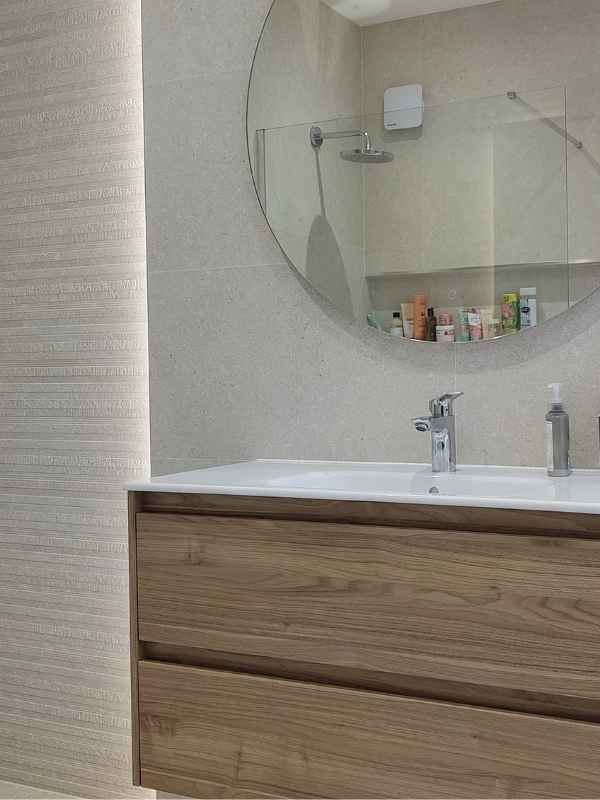
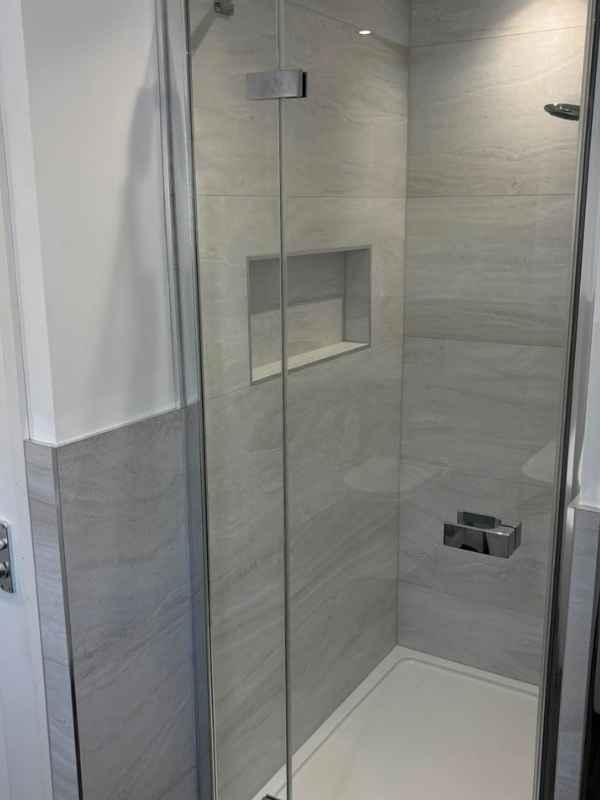
Layout patterns and grout strategies for an oversized tiles bathroom
The layout you choose shapes the room as much as the tile itself. A vertical stack on walls can draw the eye upward and makes low ceilings feel higher. A horizontal stack does the opposite: it widens a narrow enclosure visually. If you want a brick or offset pattern, keep the offset to around one third rather than half; this minimises lippage risk and reads as more considered and modern at large scale. The most powerful effect in a wet room is running the same large-format tile continuously from the floor up the wall, creating a seamless, spa-like wrap, though this only delivers when drainage slope and waterproofing are designed from the outset with that layout in mind.
Grout colour deserves as much thought as the tile. Tone-on-tone grout, closely matched to the tile, makes the surface read as one piece, the go-to for a calm, contemporary finish and the approach that gets the most from large-format tiles. Slightly contrasting grout can be used deliberately to emphasise the geometry, which works well with a bold stacked layout. Darker grout hides staining better but draws attention back to the joints, which counteracts the seamless effect you are probably trying to achieve. For most bathrooms, matching or near-matching grout is the safest and most effective choice.
What installation actually involves
Large-format tiles are unforgiving of a poor substrate. The surface must be structurally sound, clean, and flat to within roughly 3mm over 2 metres. High spots are removed; low spots are filled with a self-levelling compound before any tile is laid. In wet areas, a continuous waterproofing membrane goes down first, with taped corners and sealed penetrations around pipes and outlets. None of these substrate-preparation steps is optional, skipping them is how a tiled floor that looks perfect at handover develops lippage and cracking relatively quickly.
Adhesive, levelling, and large-format tile installation
The adhesive specification matters too. A flexible tile adhesive is the standard for large-format tile installation and for projects over underfloor heating, where movement stress is a factor. A tile levelling system (TLS) keeps adjacent tiles flush while the adhesive cures; without one, even slight lippage is obvious and irreversible at this scale. At Vortex Bathrooms, using a TLS is standard practice on every large-format project. Precision cutting, correct adhesive coverage, and controlled levelling take experience, and the result shows it.
What to budget for large-format tiles in the UK
Supply costs vary considerably. Standard ceramic tiles typically start from around £25 to £50 per m², while large-format and oversized porcelain generally sits in the £40 to £100+ per m² range depending on format, brand, and finish. These are typical 2026 UK market estimates. Slab formats sit at the top end and normally require a specialist supplier quote rather than an off-the-shelf price. Labour costs follow a similar pattern: standard tiling runs roughly £45 to £60 per m², while large-format work typically runs £50 to £95 per m² depending on tile size, substrate condition, and layout complexity. The premium is driven by longer preparation time, a slower laying pace, more complex cuts, and the levelling system.

Making the right call
The key decisions are connected: match tile size to room scale, specify a matte or textured finish for wet floors, choose tone-on-tone grout for a seamless result, and plan for proper substrate preparation before a single tile goes down. When specified and fitted correctly, an oversized tiles bathroom scheme delivers a finish that looks larger, feels more luxurious, and is genuinely easier to keep clean over time.
The tile is only as good as the surface beneath it. A well-prepared substrate is what sustains a showroom finish for years; poor preparation often leads to visible issues far sooner than expected. The team at Vortex Bathrooms handles every stage, from substrate assessment to the final tile. Talk to us about your project.